
Doors that open, thresholds to cross, stories that invite visitors to step into the heart of Savignano Irpino. The art installations create a symbolic journey through the places, history and values that have shaped the village’s identity over time.
Each door opens onto a different aspect of the local area: water as the source and memory of community life; devotion as a spiritual bond between generations; the land as a source of work, knowledge and traditions; Guevara Castle as the guardian of history; and the coat of arms as an embodiment of the symbols with which the community identifies.
Stepping through these doors means going beyond what meets the eye, allowing yourself to be guided on a journey of discovery through landscapes, traditions, knowledge and living heritage. The route thus becomes a journey into the collective memory, bridging the past and the present and revealing the true spirit of Savignano Irpino.
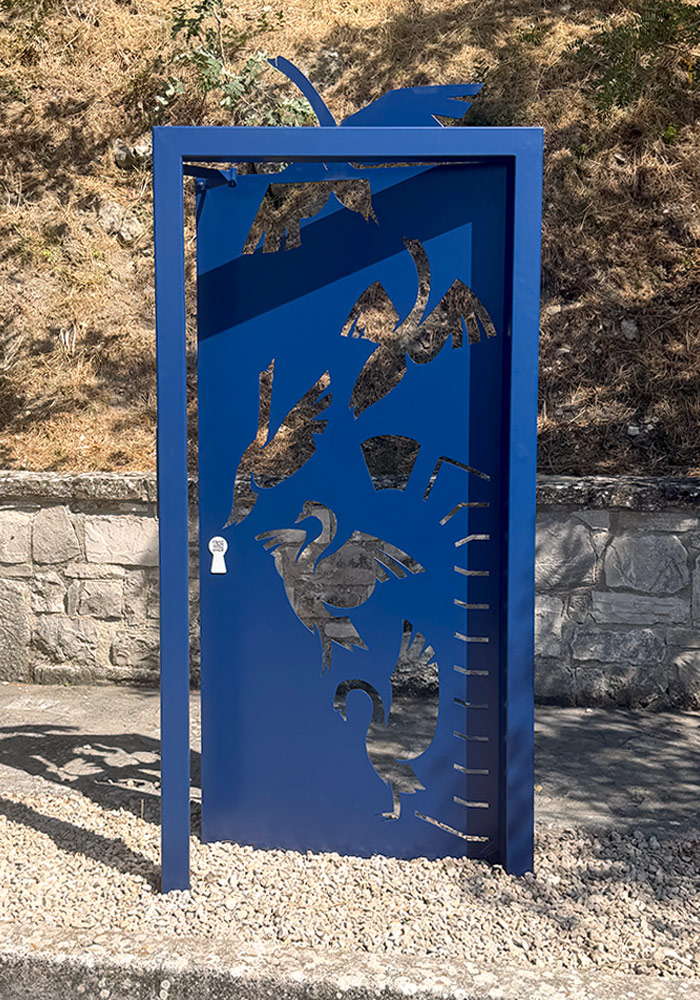
Where water flows, a story begins.
Here, you are not simply looking at a work of art: you are crossing a threshold. The Porta dell’Acqua leads into the most fluid and vibrant heart of Savignano Irpino, where water is not just a natural element, but a source, a memory and a continuity.
The swan, the central figure of the installation, rises up and extends beyond the boundaries of the structure, breaking the static nature of the form. It is the symbol of free-flowing water, which cannot be contained, which flows through the landscape and defines it. Its outward movement suggests that what you are beginning here does not end at the doorway, but continues into the real landscape. This threshold is dedicated to the Fontana Angelica, a landmark of the village, a meeting point between history, everyday life and collective memory. The water that flows here is the same water that has accompanied generations, becoming a silent yet essential part of village life.
Now that you’ve stepped through this first door, the journey has begun.
Continue exploring the other installations: each one will guide you through a new part of Savignano Irpino.
The Fontana Angelica, in the heart of Savignano Irpino’s historic centre, is one of the most significant examples of the town’s water history and remains a symbol of its identity to this day. Fed by a spring originating from Monte Sant’Angelo, at an altitude of around 800 metres, it dispenses water through three cast-iron swans – affectionately known by the people of Savignano as ‘papere’, hence the popular name of Papere Fountain.
Designed by Federico Castelluccio of Monteleone di Puglia to address the village’s long-standing water shortage, it came into operation in 1912 and immediately became a vital part of daily life. Before the aqueduct was built, this was where the women would go every day to fetch water, carrying it in traditional varrili, with a cloth protecting their heads (sparra). For those who were unable to do so, there were the ‘acquaiole’ – young women who carried out this service for the community.
With the introduction of the Biferno aqueduct in the late 1960s, these practices gradually disappeared. Today, the fountain retains its symbolic and historical significance: no longer a source of water, but a living reminder of a time when water was part of daily life, a shared bond and a shared necessity.
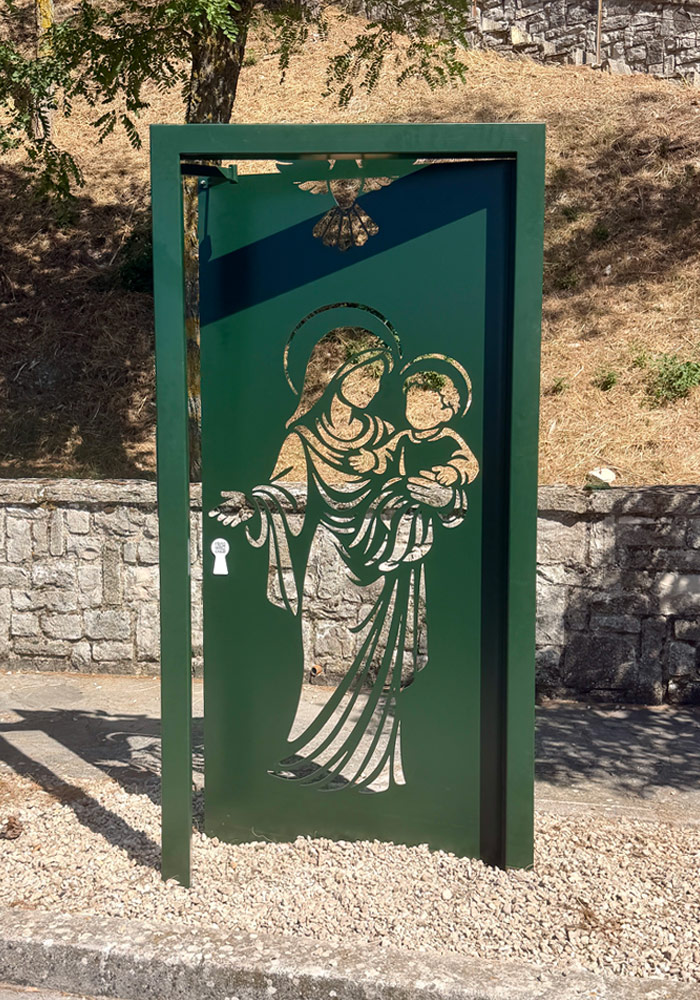
Faith is passed down from generation to generation, just like life.
This door leads you into a more intimate aspect of the local area – that of devotion and spiritual identity, which has united the community of Savignano Irpino for centuries.
At the heart of the work, Saint Anne with the Child Mary embodies the most profound act: transmission. Not only of faith, but of values, roots and a sense of belonging. It is an image that speaks of care, protection and continuity across generations.
The composition is not static: it is alive, just as the village’s devotion is alive. Here, faith is not merely a memory, but a daily presence, a shared ritual, a bond that spans time and is renewed in people.
This door invites us to recognise spirituality as a cornerstone of local identity, an invisible thread that binds the past and the present together.
Carry on with your journey.
Other doors await you, ready to reveal Savignano Irpino to you from fresh perspectives.
At the heart of the Mother Church of St Nicholas the Bishop, built in 1588 on the site of the ancient medieval settlement and consecrated in 1695 by Cardinal Vincenzo Maria Orsini (later Pope Benedict XIII), lies one of the most significant sites of devotion in Savignano: the Chapel of St Anne.
Rebuilt a fundamentis thanks to the efforts of Don Lorenzo Palmieri, who promoted the veneration of the Virgin Mary’s mother throughout the village, the chapel remains a spiritual focal point for the community to this day. Inside, there is a fine 18th-century wooden statue of Saint Anne, flanked by three paintings created between the late 19th and early 20th centuries, depicting episodes from her life.
Devotion to Saint Anne, which is deeply rooted in the local area, is linked to the symbolic significance of motherhood and the passing on of the faith, making her a figure who embodies the community’s identity, spanning generations and continuing to live on in the community’s memory and rituals.
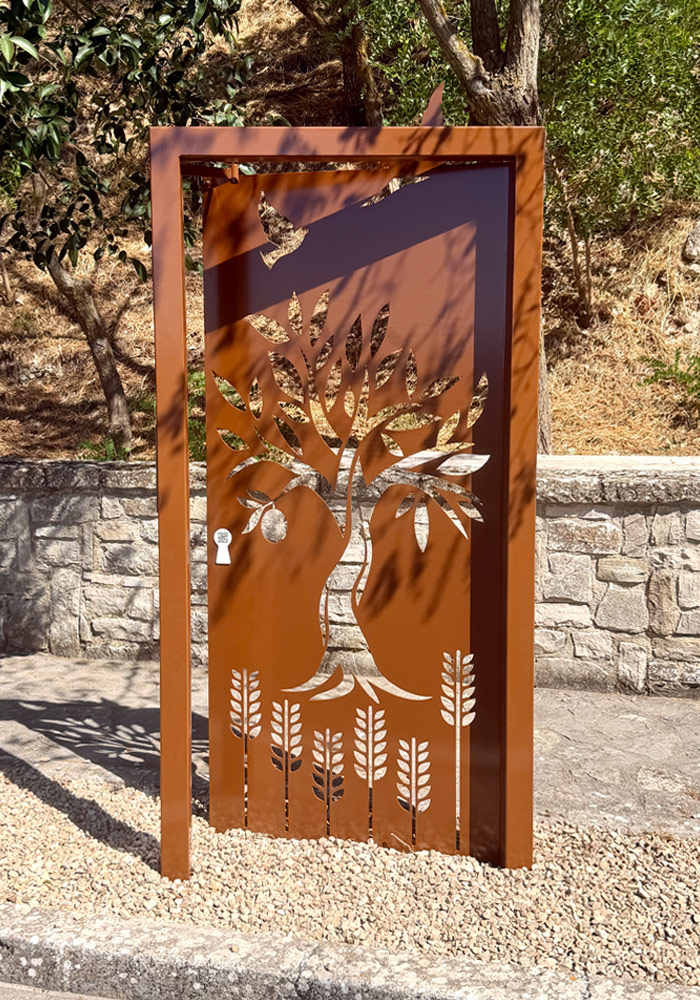
You don’t just look at the earth. You live it.
As you step through this door, you enter the agricultural heart of Savignano Irpino, where the land is not merely a place of production, but the deep-rooted foundation of identity. The olive tree, with its simple yet resilient form, represents the passage of time, continuity and memory. It is the symbol of a culture rooted in patience and knowledge passed down through the generations. Beside it, the ears of wheat tell the story of the cycle of life, shared labour and the constant relationship between humankind and nature.
The balance between these elements paints a picture of a landscape shaped over time, where every season has its own significance and every action its own value. This door invites you to recognise the land not merely as a resource, but as a living cultural heritage that continues to define the landscape and the community to this day.
Carry on along the path.
Every door is a new gateway to learning about Savignano Irpino.
Wheat has always been the cornerstone of Savignano Irpino’s economy and agricultural culture, with evidence of its presence dating back to Roman times, when the area’s fertile valleys were devoted to its cultivation. For centuries, as a staple food and a measure of wealth, it has set the rhythm of rural life: from ploughing and winter sowing to the summer harvest and the processing of the grain into flour. Even today, prized varieties are still grown, including durum wheat and ancient cultivars such as Saragolla and Risciola.
The olive tree, introduced in more recent times, has gradually found its place in the local agricultural landscape. Among the most characteristic varieties, the Ravece stands out; native to Irpinia, it produces an extra virgin olive oil of exceptional quality, renowned for its fruity character and well-balanced notes.
Together, wheat and olive trees tell the story of the region’s evolution: symbols of agricultural expertise that combines tradition and adaptation, and which still today shapes the landscape and the identity of the Savignano community.
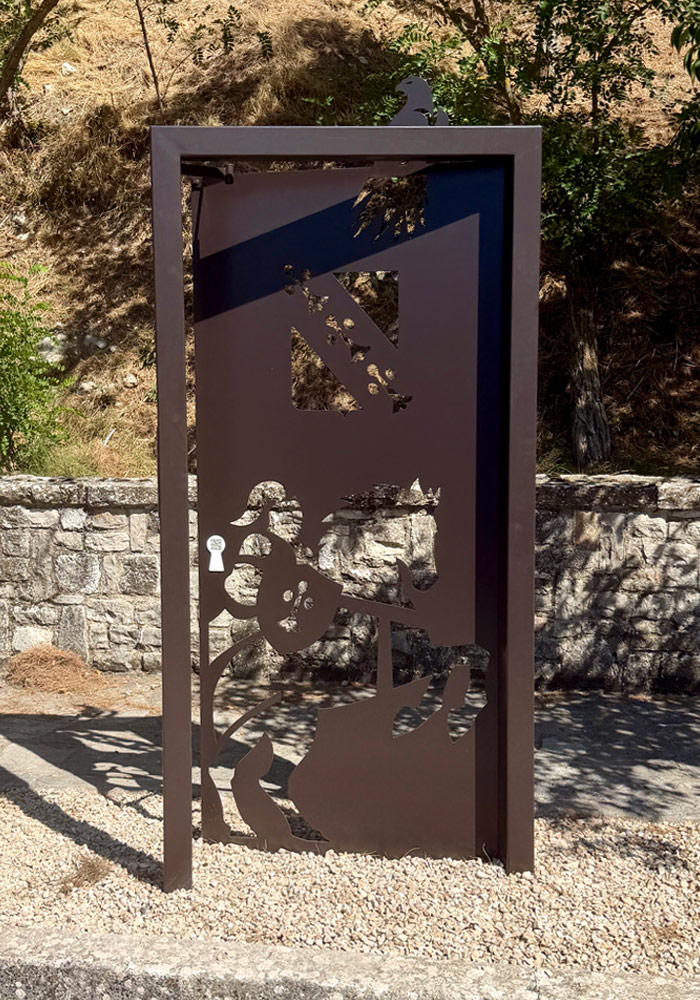
History does not remain. It passes through.
This gate offers a glimpse into the history of Savignano Irpino, dominated by the presence of the castle, a symbol of control, defence and continuity through the ages.
The figure of the knight on horseback conveys a dynamic image of history: not something static, but a force in motion, made up of events, transitions and transformations. The heraldic elements reinforce the link with the historical roots and the identities that have shaped the region.
The castle, a visual and symbolic landmark, serves here as the key to understanding the entire village: a privileged vantage point over the landscape and the guardian of its history.
Stepping through this door means entering a narrative that spans the centuries and is still reflected today in the places, the architecture and the visible traces of the past.
Carry on exploring.
The journey continues through other doors, other stories, other perspectives.
Guevara Castle stands on the southern slope of Tombola Hill, at the highest point in Savignano Irpino, in a strategic position overlooking the pass between Campania and Puglia along the Cervaro Valley. Of Norman origin, it formed part of the first fortified settlement of the Castrum Sabinianum and served an essentially defensive purpose.
Over the centuries, following the arrival of the Guevara family in the 15th century, the castle was transformed into a stately home, taking on the name by which it is known today. The building is arranged over two storeys: the upper floor comprises the stately rooms, whilst the lower floor houses the service quarters. The family crest, situated next to the entrance, is still visible.
A place marked by historical events and changes in power, the castle has undergone numerous alterations over the years, from Renaissance-era restoration work right up to the most recent work, carried out following the 1980 earthquake. Today, it stands as a symbol of the village’s identity and offers a prime vantage point from which to appreciate the history and landscape of Savignano Irpino.
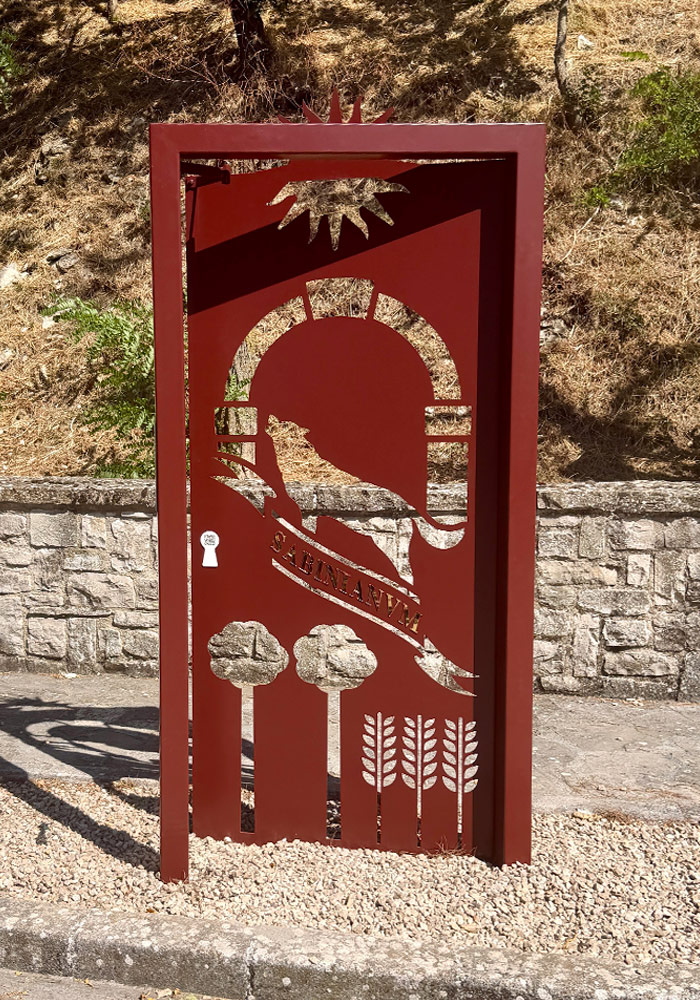
A symbol, a story, a community.
This gate brings together and showcases the symbols that define Savignano Irpino, as encapsulated in the town’s coat of arms: a representation that unites nature, history and identity.
The wolf, the central figure, symbolises the origins and strength of the local area. The sun above represents energy, continuity and openness. The arch serves as a gateway and a welcome, evoking the entrance to the village and a sense of belonging. At the base, trees and ears of wheat ground the narrative in the land, its fertility and the daily life of the community.
In this composition, each element helps to create an immediate and recognisable visual language, capable of expressing identity in a contemporary form.
This door is not just to be looked at, but to be understood: it is an invitation to recognise oneself in the symbols that tell the story of the local area.
Now the path lies in your hands.
Continue exploring Savignano Irpino by passing through the other gates and letting its landmarks guide you.
The coat of arms of Savignano Irpino symbolically embodies the historical and cultural identity of the area. It consists of a shield surmounted by a turreted crown, flanked by laurel and oak branches – elements that evoke dignity, strength and continuity. Within the shield, the symbols are arranged in a composition that illustrates the deep bond between humankind, nature and history.
The ears of wheat represent the region’s main resource and the foundation of the rural economy, whilst the trees evoke the natural wealth and fertility of the land. The sun, placed in a prominent position, symbolises energy, life and openness. Central to the design is the figure of the wolf, the emblem of the people of Irpinia: according to tradition, it was a wolf that – hirpus in the Samnite language – guiding the ancient peoples towards these lands, shaping their destiny.
The band bearing the inscription ‘SABINIANUM’ evokes the village’s historical origins, linked to the ancient settlement from which the present-day community developed. Within this ensemble of symbols, the coat of arms becomes a visual narrative of a borderland, where memory, nature and identity continue to coexist and recognise one another.
| Cookie | Duration | Description |
|---|---|---|
| cookielawinfo-checbox-analytics | 11 months | This cookie is set by GDPR Cookie Consent plugin. The cookie is used to store the user consent for the cookies in the category "Analytics". |
| cookielawinfo-checbox-functional | 11 months | The cookie is set by GDPR cookie consent to record the user consent for the cookies in the category "Functional". |
| cookielawinfo-checbox-others | 11 months | This cookie is set by GDPR Cookie Consent plugin. The cookie is used to store the user consent for the cookies in the category "Other. |
| cookielawinfo-checkbox-necessary | 11 months | This cookie is set by GDPR Cookie Consent plugin. The cookies is used to store the user consent for the cookies in the category "Necessary". |
| cookielawinfo-checkbox-performance | 11 months | This cookie is set by GDPR Cookie Consent plugin. The cookie is used to store the user consent for the cookies in the category "Performance". |
| viewed_cookie_policy | 11 months | The cookie is set by the GDPR Cookie Consent plugin and is used to store whether or not user has consented to the use of cookies. It does not store any personal data. |

Discover the World, one Full Adventure at a Time!
1080 Brickell Ave - Miami
United States of America
info@travel.com
Travel Agency +1 473 483 384
Info Insurance +1 395 393 595


